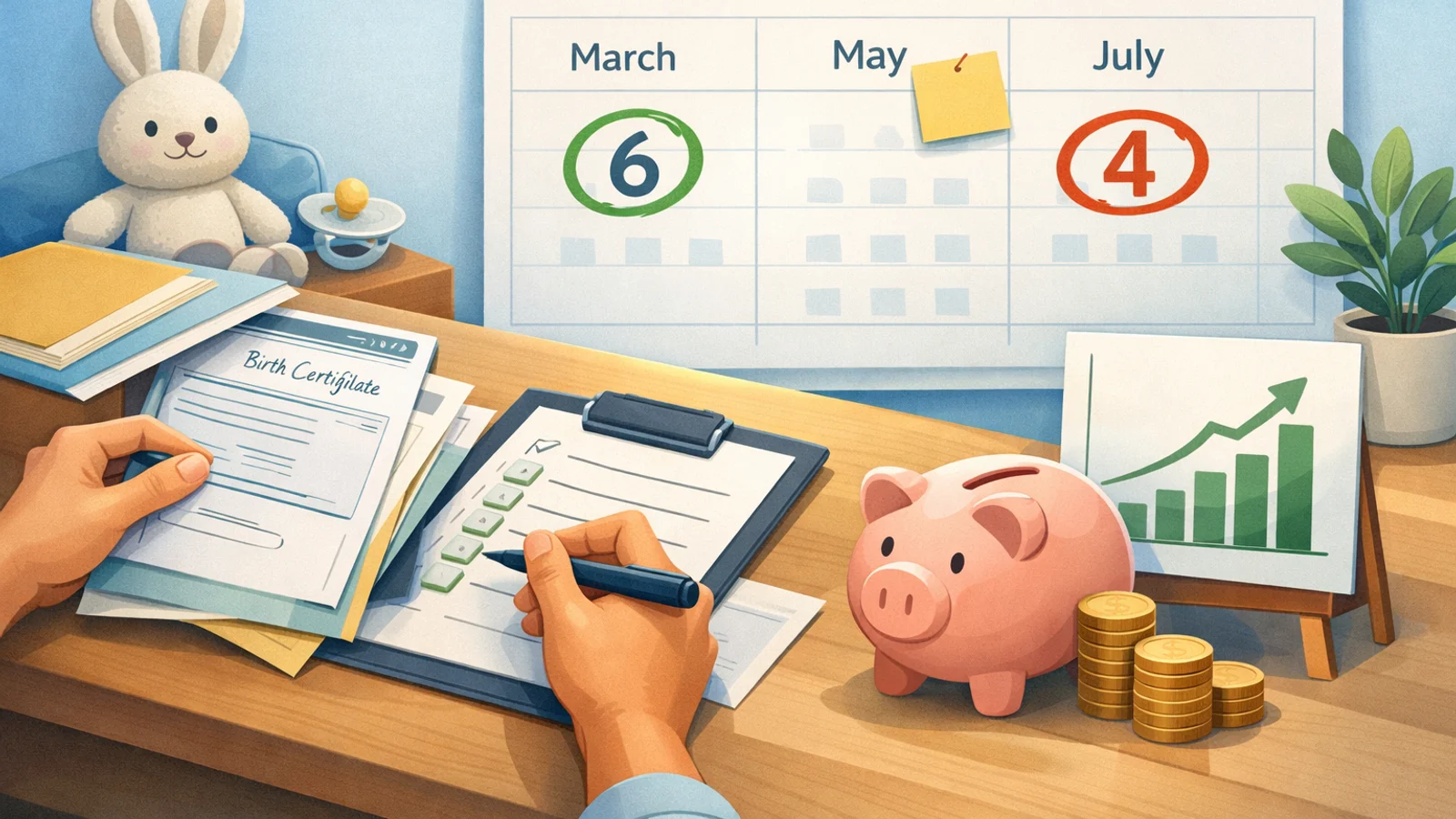
Parents are starting to ask the same practical questions about Kid Saving Account in March 2026: What is actually changing this year, what can I do now, and what has to wait until summer?
Here is the short version.
Public IRS and Treasury guidance for the 2026 rollout says account elections for eligible children can be made during 2026, including with a 2025 tax return, and that contributions cannot be made before July 4, 2026. Treasury and IRS also issued formal guidance in late 2025 and have described a 2026 launch process tied to the new child account program. Kid Saving Account can help parents track the moving parts, but it is not a government agency and does not make eligibility or tax decisions. (irs.gov)
What parents are asking right now
1) Can I put money in today?
Not yet. The clearest public rule so far is that contributions may not be accepted before July 4, 2026. That applies to parent and family planning too: you can prepare now, but actual funding needs to wait until that date or later. (irs.gov)
2) Do I need to wait until July to do anything?
No. IRS guidance says the election to establish an account for 2026 can be made during 2026, including when filing a 2025 tax return, and related forms and online tools are expected as the rollout continues. That means the useful work in March, April, and May 2026 is mostly administrative: confirming the child qualifies, checking who will make the election, and watching for notices and form instructions. (irs.gov)
3) Is there a government seed contribution?
Current Treasury and IRS materials describe a $1,000 pilot program contribution for eligible children, with deposit timing no earlier than July 4, 2026. Families should still read the final instructions carefully because eligibility, election steps, and processing details matter. (irs.gov)
4) Who can contribute later?
The IRS says regular contribution limits apply during the growth period, and employer contributions may also be allowed under specific rules, subject to the annual cap. That is useful for parents who own a small business or who want to ask an employer about payroll-related benefits later in 2026. (irs.gov)
The practical 2026 timeline for families
For parents, the easiest way to think about the rollout is in two phases.
Phase 1: activation and paperwork, around May 2026
The key task in spring is getting ready for activation steps, tax filing coordination, and account election details. Draft IRS materials point to 2026 election handling and indicate that online election options may begin in the middle of 2026. Because agencies often update forms and instructions close to launch, parents should expect activation notices around May 2026, then verify the exact instructions when they are published. This timing is a planning expectation, not a guarantee. (irs.gov)
Phase 2: funding starts July 4, 2026
This is the date families should circle. Public IRS guidance states that contributions cannot begin before July 4, 2026, and pilot program deposits are also described as starting no earlier than that date. (irs.gov)
A simple parent checklist for March 2026
Use this checklist now so you are not scrambling in summer:
- Confirm the child’s legal name, date of birth, and Social Security number match tax records.
- Decide which parent or guardian will handle the election and future account monitoring.
- File the 2025 tax return carefully if the account election will be tied to that process.
- Watch for IRS form updates and instructions during spring 2026.
- Set a family funding goal now, even though deposits must wait until July 4, 2026.
- If grandparents want to help, decide in advance how much they may contribute once funding opens.
- If you own a business or have workplace benefits influence, ask whether employer contributions could be offered later in 2026.
Each of these steps is low-risk, practical preparation. None of them requires guessing about market returns or assuming special tax outcomes. The goal is simply to be ready when the official process opens. (irs.gov)
Planning questions worth discussing at home
Before July 4, 2026, most families do better with a short planning conversation than with more research.
Ask:
- Who will complete the election if there is more than one parent or guardian?
- Will you start with a one-time deposit or a monthly contribution pattern after July 4, 2026?
- Do you want to save for adulthood broadly, or are you mentally reserving the account for education, housing, or retirement-style long-term use?
- If a $1,000 pilot contribution applies, will you leave your own family budget unchanged or reduce other savings?
These are not legal or tax questions. They are household planning choices, and getting them settled early makes the launch less confusing.
What Kid Saving Account should help parents focus on
For a brand like Kid Saving Account, the timely angle in March 2026 is not hype. It is readiness.
Parents mainly need three things right now:
- A date-based plan — expect activation-related updates around May 2026 and funding beginning July 4, 2026.
- A paperwork plan — know who is filing, who is electing, and which child records must match.
- A contribution plan — decide in advance what your family wants to add once deposits are allowed.
That is the practical middle ground between doing nothing and overreacting to headlines.
Bottom line
As of March 17, 2026, the most useful update for parents is straightforward: prepare now, watch for spring activation instructions, and do not expect to fund the account before July 4, 2026. Public IRS and Treasury guidance supports that timeline, including the possibility of a $1,000 pilot contribution for eligible children. Kid Saving Account can organize the questions parents are asking, but families should still verify final instructions from official IRS and Treasury materials when the launch steps are published. (irs.gov)