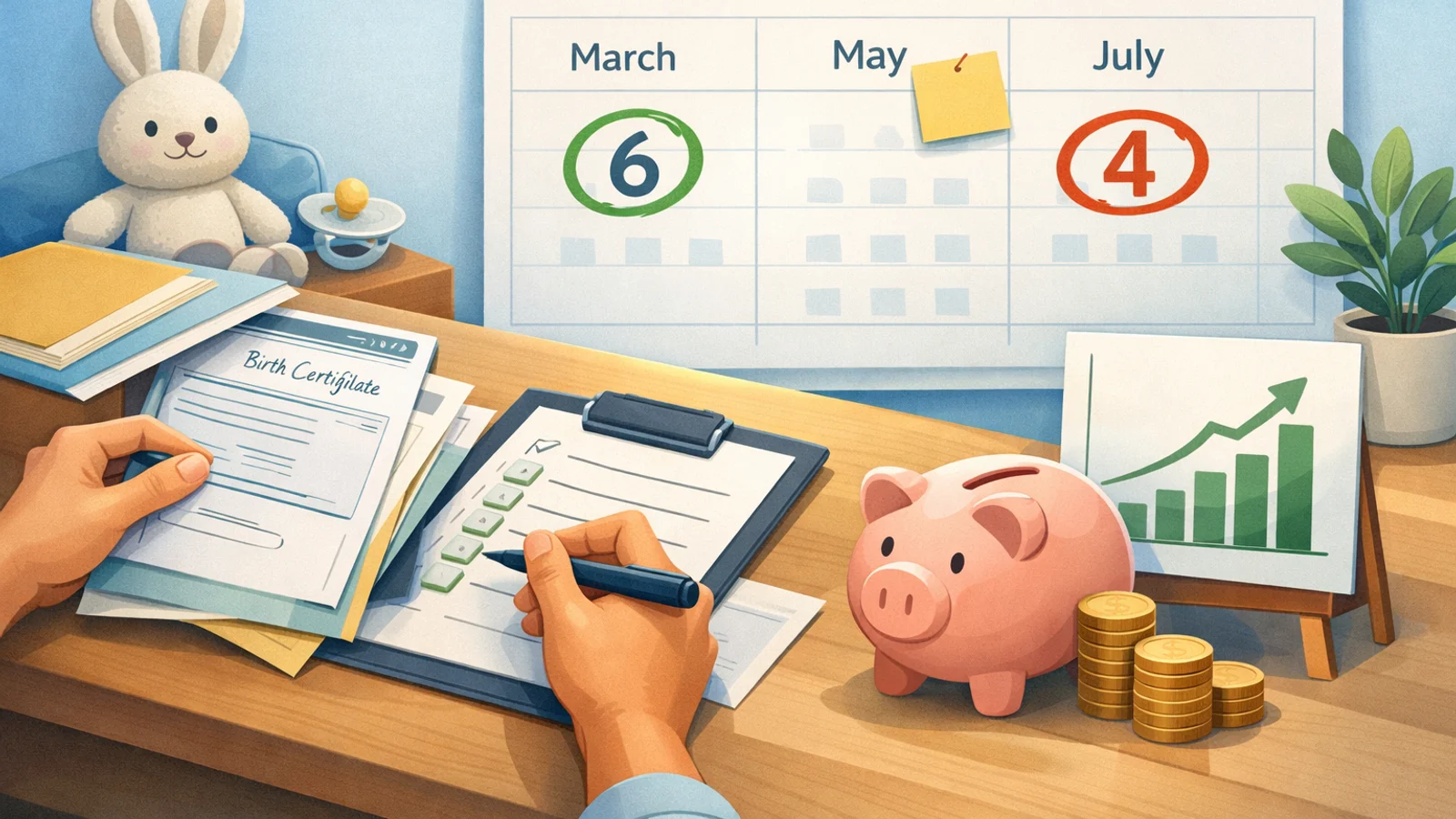
Parents trying to follow the 2026 rollout have a short list of practical questions right now: Is my child eligible, when do I need to act, and what happens first? Based on public guidance released in early March 2026, the clearest timeline is this: election steps can begin in 2026, activation information is expected to start going out around May 2026, and account contributions are scheduled to start on July 4, 2026. For families using Kid Saving Account to stay organized, the immediate job is less about guessing returns and more about getting documents, timing, and contribution plans ready. (irs.gov)
The main parent questions in March 2026
Here are the questions that matter most right now:
- Who qualifies? Current IRS guidance says the pilot contribution rules apply to eligible children born in 2025, 2026, 2027, or 2028, subject to the program’s election requirements. (irs.gov)
- When does the account become usable? Public White House and IRS materials indicate activation notices are expected to begin around May 2026 after an election is made and an authentication step is completed. (whitehouse.gov)
- When can money actually go in? Contributions are slated to begin on July 4, 2026. IRS bulletin material also says a pilot contribution will be deposited no earlier than that date. (whitehouse.gov)
- How much can families add? Current public summaries say the annual contribution limit is $5,000 total per child, with cost-of-living adjustments after 2027. (whitehouse.gov)
- Do parents need to wait for a preferred brokerage? No. Public guidance says accounts are expected to start with Treasury’s designated financial agent, with the possibility of a later transfer to a preferred brokerage firm. (whitehouse.gov)
A simple planning checklist for parents
If you want to be ready without overcomplicating it, use this sequence:
- Confirm birth-year eligibility. If your child was born in 2025, 2026, 2027, or 2028, they may fall within the current pilot contribution framework, but the election details still matter. (irs.gov)
- Watch for election instructions. IRS materials reference Form 4547 and indicate elections may be made in 2026, including with a 2025 return once the form is available. (whitehouse.gov)
- Prepare for activation around May 2026. The person making the election should expect an authentication step before the initial account is fully opened. (whitehouse.gov)
- Set a July 4, 2026 reminder. That is the key date for the start of contributions under current public guidance. (whitehouse.gov)
- Choose a contribution rule now. Even a modest automatic amount can be easier to maintain than waiting for a perfect plan.
What is actually new this month
The biggest recent development is the March 6, 2026 IRS and Treasury release of proposed regulations for the contribution pilot program. That matters because parents now have a more concrete public framework for eligibility, elections, and Treasury’s planned one-time $1,000 pilot contribution for eligible children once the required steps are completed. (irs.gov)
That does not mean every operational detail is final today. The regulations are proposed, the form rollout is still part of the practical implementation, and activation and funding still follow the 2026 timeline above. For parents, the useful takeaway is to treat March 2026 as a preparation window, not the finish line. (irs.gov)
How Kid Saving Account can help families stay organized
Kid Saving Account is not a government agency, and it cannot approve eligibility or guarantee tax results. What it can do is help parents keep the real-world process manageable:
- track the child’s birth year and household timeline,
- save reminders for May 2026 activation follow-up,
- set a family contribution target before July 4, 2026,
- note whether grandparents or employers may want to contribute later, and
- keep questions in one place for a tax professional or plan administrator.
That approach is especially useful because the public materials suggest several contribution paths may eventually matter, including parent, family, and some employer-related contributions. (whitehouse.gov)
A practical way to compare your next step
If you are deciding what to do next, use this simple comparison:
If your child is already born and appears eligible
- Review current IRS guidance.
- Watch for the election process and activation notices.
- Build your first-year contribution plan before July 4, 2026. (irs.gov)
If you are expecting a baby in 2026
- Save delivery and identification records carefully.
- Plan for the election step in the child’s birth year if applicable.
- Decide in advance whether you want to start with a small recurring contribution or occasional gifts. (irs.gov)
If you are still unsure whether to participate
- Focus first on eligibility and timing.
- Avoid assuming every detail is final until implementation materials are fully live.
- Use Kid Saving Account as your planning dashboard, then confirm tax or legal questions with a qualified professional. (irs.gov)
Bottom line for parents on March 18, 2026
The most useful update is not hype. It is clarity. As of Wednesday, March 18, 2026, the public timeline parents should work from is: proposed guidance released March 6, 2026, activation information expected around May 2026, and contributions beginning July 4, 2026. If your family may be eligible, this is a good time to organize records, watch for election details, and decide how much you would realistically contribute once the window opens. (irs.gov)